Ever seen an identification tag so faded you had to zoom in on a photo just to read a number? That’s the kind of problem a tag built for outdoor use should help prevent.
Fading isn’t the only concern. An outdoor tag also needs material that resists corrosion and sunlight, durable markings, text you can read from a normal working distance, and mounting hardware that stays secure through wind and rain. Recessed characters are less exposed to surface abrasion, making an engraved or stamped tag made from stainless steel or anodized aluminum worth considering for outdoor use.
Here’s what we’ll cover:
- Why recessed characters generally last longer than printed ink
- Five visibility features that keep numbers readable
- Mounting hardware that holds up to wind, salt, and sun
- Which tags suit different sites, what causes them to fail, and how to maintain them
Why Do Outdoor Identification Tags Require Different Design Considerations?
Outdoor tags face sunlight, rain, temperature swings, grit, and wind, plus salt near coasts and roads treated in winter. A paper tag or indoor-grade plastic tag might last for years in a mechanical room but deteriorate much sooner outside.
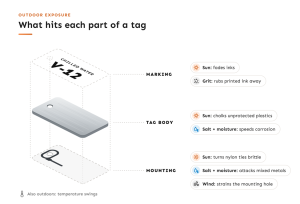
Ultraviolet (UV) light can fade inks, chalk plastics without UV protection, and make ordinary nylon ties brittle. Salt and moisture can speed up corrosion, especially where dissimilar metals touch and moisture collects. Wind creates a different problem: a loose tag can flap repeatedly, putting strain on its mounting hole.
When a tag carries safety information, faded markings or a failed attachment can become more than a maintenance problem. OSHA’s lockout/tagout rule requires tagout devices to withstand their environment for the maximum expected exposure, without weather or moisture causing deterioration or making their messages illegible. Ordinary valve and asset ID tags aren’t automatically covered by that rule, but they should still remain readable and securely attached for their intended service life.
How Do Engraved, Stamped, and Printed Tags Compare Outdoors?
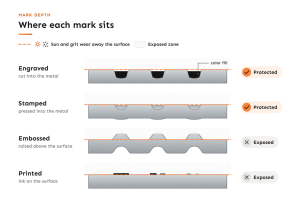
Engraved and stamped tags generally hold up better than ordinary surface-printed tags in harsh outdoor conditions because their characters are cut or pressed into the material. Printed ink can fade in sunlight or rub away under grit, while recessed characters are less exposed to that damage. Embossing raises characters above the surface instead.
| Method | How the mark is made | Readability feature | Main limitation |
| Engraved | Cutter or engraving laser removes material | Recessed characters can remain visible after color fill fades | Shallow cuts or poor contrast can reduce readability |
| Stamped | Hardened dies press characters into metal | Impressions can remain visible without ink | Thin stock can warp under deep strikes |
| Embossed | Dies raise characters above the surface | Raised characters can be seen and felt | Raised details can wear or flatten |
| Printed | Ink or other printing media forms the characters | High-contrast text and graphics | UV and abrasion resistance depend on the ink, material, and protective finish |
For engraved and stamped tags, depth still matters. A shallow cut or impression may be hard to read once its color fill wears away.
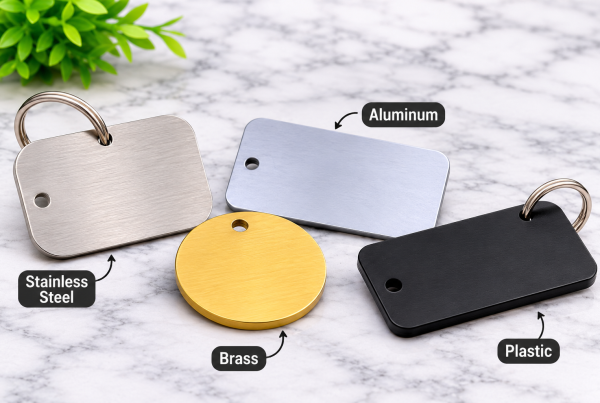
Even a deep mark won’t help much if the tag itself corrodes. 316 stainless steel contains molybdenum, which improves its resistance to chloride corrosion, making it a strong choice for coastal areas and roads exposed to salt. For a lighter option, anodized aluminum offers a protective oxide layer and often costs less, as the guide to choosing tag materials explains.
5 Design Features That Improve Outdoor Tag Visibility
A crew should be able to read an outdoor tag at a glance without having to zoom in with a phone camera.
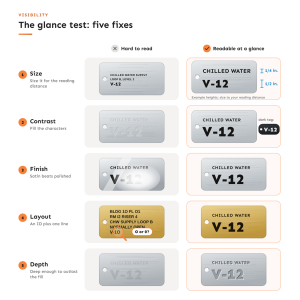
- Size characters for the reading distance. OSHA requires signal words on covered accident-prevention tags to be readable from at least 5 feet. Some stamped valve tags use 1/4-inch lettering on the top line and 1/2-inch numbers below. Whether those sizes are large enough depends on how far away crews need to read the tag.
- Fill recessed characters with a contrasting color. Black fill gives stainless steel, brass, and plain aluminum strong contrast, while white fill works well on dark anodized surfaces.
- Pick a satin or matte finish. Polished stainless steel and bright brass can produce glare in full sun, making the markings harder to read. A satin or matte finish helps reduce that glare.
- Keep the layout short and unambiguous. When deciding what belongs on a metal tag, keep routine ID tags to an identifier and one line of context where possible. Even a short ID can be misread when O and 0 or I and 1 look alike.
- Specify marks deep enough to outlive the fill. Deep marks can remain readable even after the color wears away. A grower on a fruit-tree forum reported a similar result with aluminum tags: the ballpoint ink had disappeared, but the pressed indentations were still readable.
How Does Tag Construction Prevent Physical Damage Outdoors?
Thick stock, rounded corners, and well-placed holes help outdoor tags withstand impacts and repeated movement.
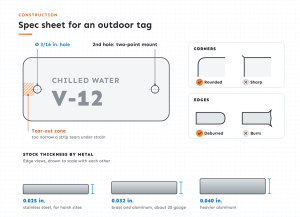
Thickness sets the baseline for strength. Many stamped brass and aluminum valve tags use 0.032-inch stock, approximately 20-gauge. Heavier aluminum options measure 0.040 inch, while thinner 0.025-inch stock may be enough for sheltered, lower-impact jobs. Beyond thickness, edge finishing is another sign of a high-quality industrial metal tag. Rounded corners resist snagging and curling, while deburred edges remove rough spots that can become weak points.
Even sturdy stock can fail at the mounting point. A 3/16-inch hole, common on stamped valve tags, can accommodate S-hooks, bead chains, and ties. If the hole sits too close to the edge, the narrow strip of metal between the hole and the edge can tear under strain. The metal may hold, but a tag swinging in the wind can still strain its fastener. Orchard owners have reported thin wires snapping after a year or two as their tags flapped in the breeze. Where the mounting surface allows, a second hole lets you secure an engraved or stamped tag at two points so it doesn’t swing as freely.
Which Mounting Methods Keep Outdoor Identification Tags Secure?
For long-term outdoor use, rivets, screws, and metal ties can hold a tag more securely than adhesives or ordinary nylon ties. The best choice depends on where the tag will hang and how much movement it will face.
| Mounting method | Common applications | Main consideration |
| Stainless bead chain or wire rope | Valves, pipes, and poles | Loose loops can wear or enlarge the mounting hole |
| Flexible aluminum ID cable ties | Pipes, posts, and identification bundles | Short Order Products specifies a length of (3.14 × diameter) + 0.75 inch for its aluminum ties |
| UV-stabilized black nylon ties | Lighter-duty outdoor installations | Check UV resistance, strength, and expected exposure |
| Rivets or stainless screws | Flat panels and housings | Use compatible metals or suitable isolation between dissimilar metals |
| Industrial adhesive | Clean, flat surfaces | Check outdoor rating, surface preparation, and application temperature |
For safety tagout devices used under OSHA’s lockout/tagout rule, attachment requirements are stricter. The rule requires attachments to be non-reusable, hand-attachable, self-locking, and non-releasable, with a minimum unlocking strength of 50 pounds and a design at least equivalent to a one-piece, all-environment-tolerant nylon cable tie. Those requirements don’t automatically apply to ordinary asset identification tags.
The fastener’s metal also needs to suit the tag. When dissimilar metals are electrically connected in the presence of moisture, galvanic corrosion can attack the less noble metal. Aluminum tags attached directly to copper wire are particularly vulnerable in wet conditions, which is why compatible hardware or proper isolation matters.
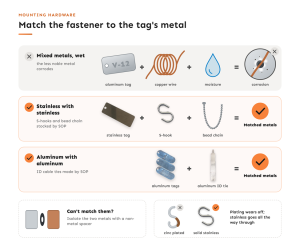
For stainless tags, Short Order Products carries stainless S-hooks and bead chain. These fittings don’t rely on a zinc coating for corrosion protection, unlike zinc-plated hooks that can become more vulnerable once their coating wears away.
5 Outdoor Installation Locations That Require Specific Tag Considerations
The right tag and mounting method also depend on what the installation site puts them through.
- Coastal docks, marinas, and boat yards. Salt spray increases the risk of corrosion, making 316 stainless tags with compatible corrosion-resistant hardware a strong choice. Aluminum can still work if it’s suitably protected and paired with compatible hardware.
- Rooftop units and solar arrays. Full sun can fade color fills and make unprotected nylon brittle. Anodized aluminum or stainless tags are practical options when mounted to an approved fixed surface without interfering with equipment access. Add the appropriate suite, unit, or meter number so maintenance crews can identify the right equipment.
- Utility poles, meters, and valve stations. Stamped aluminum or stainless tags can withstand outdoor exposure when properly secured. Stainless cable provides a flexible mounting option, while locations at risk of interference may also need tamper-resistant fasteners.
- Chemical, wastewater, and treatment plants. Chemical exposure and moisture can damage both the tag and its hardware. An engraved or stamped tag made from 316 stainless may work in many wet environments, but the material must be checked against the specific chemicals present. Brass is another material to assess, since sulfide gases can darken its surface.
- Construction sites and heavy-equipment yards. Vibration, grit, and pressure washing can damage exposed markings and loosen attachments. Riveted stainless plates with deep characters, mounted on a protected face of the equipment, can reduce those risks.
What Causes Outdoor Identification Tags to Become Difficult to Read?
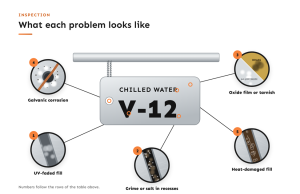
Outdoor tags become difficult to read when color fill fades, grime builds up in recessed characters, metal tarnishes or corrodes, or heat damages the markings. Older HVAC condenser labels show one way this happens: sunlight can damage the printed surface until it starts peeling and the model number becomes unreadable.
| Cause | What you may notice | Recommended action |
| UV-faded fill | Characters lose contrast against the metal | Restore contrast with a compatible, UV-resistant fill where permitted |
| Grime or salt in recesses | Dirt or salt deposits obscure the characters | Clean gently using a method suitable for the tag and equipment |
| Oxide film or tarnish | White corrosion products on aluminum or dark patina on brass | Clean or replace the tag if the markings are no longer legible |
| Galvanic corrosion | Corrosion deposits, pitting, or damage around mounting holes | Replace affected hardware and use compatible metals or proper isolation |
| Heat-damaged fill | Discolored, blistered, or missing fill near hot equipment | Use a fill rated for the actual service temperature |
A tag’s metal and its ink fill can have very different temperature limits. According to Brady’s B-907 brass valve tag datasheet, the tag has a service temperature of up to 1,200°F, but its ink fill is limited to 180°F.
How Can Businesses Maintain Outdoor Identification Tags After Installation?
Regular inspections, cleaning, touch-ups, hardware checks, and recordkeeping help businesses keep outdoor tags readable and securely attached.
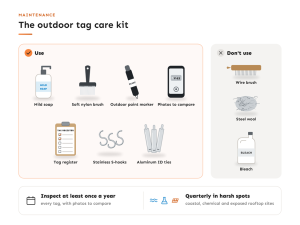
- Inspect every tag on a schedule. Inspect every tag at least once a year, or quarterly in coastal areas, chemical-exposure environments, and exposed rooftop locations. Photograph any fading or damage so you can compare it at the next inspection.
- Clean tags without scratching the surface. Wash tags with mild soap and water, using a soft nylon brush when needed. Avoid wire brushes and steel wool, which can scratch the finish or leave iron particles behind. Bleach can also damage metal surfaces, including stainless steel.
- Touch up lettering before it becomes hard to read. Use an outdoor-rated paint marker suitable for the tag material to restore faded lettering, then wipe excess paint from the face while leaving the recesses filled.
- Check hardware at every visit. Replace chalky nylon ties and secure loose cables before the tag works free. Check for white powder around mounting holes, which may indicate corrosion, including galvanic corrosion where dissimilar metals meet.
- Keep a register of every tag. Record each tag’s ID, location, material, installation date, and condition. Use those records to identify tags that need replacing, keeping the same ID and required information while correcting any design problem that caused the failure.
Get Custom Engraved & Stamped Tags for Outdoor Use From Short Order Products!
Short Order Products, a family-owned business since 1989, supplies engraved, stamped, and blank metal and plastic tags from Clover, South Carolina. The team laser- and rotary-engraves aluminum, brass, stainless steel, and outdoor-rated plastics. On clear aluminum, the shop can also darken engraved markings through acid oxidation.
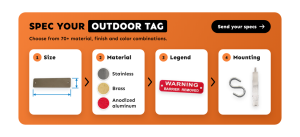
For outdoor applications, the shop offers engraved and stamped metal tags in materials suited to different levels of weather exposure, chemical contact, and frequent handling. Customers can choose from more than 70 combinations of materials, finishes, and colors, with small order minimums. The shop also offers blank metal tags and metal stamps for customers who prefer to do their own marking. Custom orders may take a week or longer before they’re shipped, usually by UPS. FedEx or USPS shipping can be arranged by phone.
Not sure which material or finish to choose? Read what to look for in engraved and stamped tags, then submit your preferred size, material, legend, and mounting method through the custom engraving page.
Frequently Asked Questions (FAQs)
Q1. What Is the Purpose of Using Tags?
Tags identify an asset, part, or location and carry the details workers need. Outdoors, crews can use them to distinguish one valve, meter, or unit from another without checking drawings.
Q2. How Long Do Durable Outdoor Labels Typically Last?
Outdoor-rated vinyl and polyester labels can last about 3 to 8 years, depending on sunlight, moisture, and how well the adhesive holds. Engraved or stamped stainless steel and anodized aluminum tags can last 10 to 30 years, depending on exposure. Unlike printed labels, their markings are made directly on the meta.
Q3. Are Custom Sizes Available for Outdoor Identification Tags?
Yes, Short Order Products makes outdoor tags in custom shapes and sizes, with square, rounded, or notched corners. The shop offers die-cut metal disks and 1-1/4-inch laser-engraved anodized aluminum disks, as well as custom nameplates sized to fit the asset. When requesting a quote, tell the team what you’re tagging, how far away the markings need to be read, and how the tag will be mounted.
Q4. What Is the Best Material for Outdoor Identification Tags?
For harsh outdoor sites, 316 stainless steel is often a strong choice because it resists salt exposure, many chemicals, and abrasion. Anodized aluminum works well for lightweight, color-coded tags, while brass suits valve tags where a darker patina isn’t a concern. Whichever metal you choose, use compatible mounting hardware to reduce the risk of galvanic corrosion at the mounting points.