
From identifying the market gap to coming up with a profitable idea, the process can go on quite smoothly when you’ve had experience in running a business. Though the dynamics can change when you’re new in this arena.
At every turn, you’d have questions swarming your mind. “Is this the right thing to do?” or a simple “What’s the least costly way to solve this problem?” — all such thoughts would keep you up at night until you’ve made the right solution. The same goes for when your business primarily focuses on leather-based accessories & goods.
Being the brains behind the brand you’ve created, it wouldn’t be justified if your products didn’t have a mark that lasted a lifetime. That said, rotary metal stamps are the perfect tool you can use to create impressions on vegetable-tanned leather — let it be a wallet, purse, belt, or gloves.
To know more about the interplay of these stamps and leather products, keep reading below!
Excelling at the Craft: How Rotary Metal Stamps Work on Leather
The deep whirring hums of the sewing machines mass-producing goods for your business aren’t that unfamiliar a rhythm to you.
Press. Hold. Repeat.
Now that’s a movement you know all too well. Interestingly, that’s also how the beat goes for working metal stamps on leather goods or making custom metal tags for your business. While the work itself isn’t that difficult, it does demand a fair bit of precision.
Placement, pressure, type of leather, and the timeframe you have to keep the leather in place — everything counts in leaving the perfect impression on the leather. But let’s jump into the details later — and sort the basics out first!
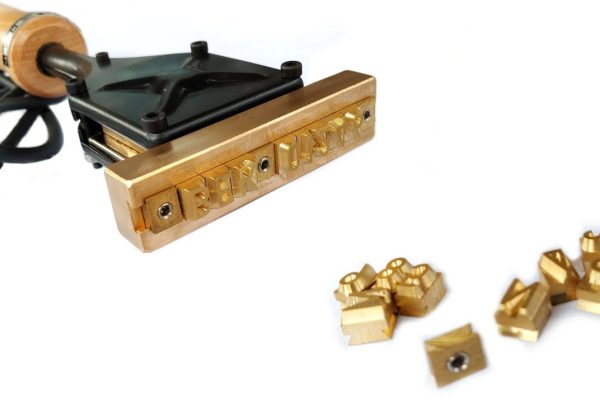
To start with the basics, metal stamps use a rotary mechanism, which works well for leaving lasting impressions on leather goods. They feature cylindrical rollers with engraved patterns that you customize through a trusted dealer. Whether it’s a text you stamp on it, your company’s logo, or a bordering pattern — uninterrupted impression is the unique selling point of these metal stamps.
Without further ado, here’s how the process works for rotary metal stamps.
1. Leather Preparation
In the initial stage of the process, you have to select the right type of leather to stamp on. Ideally, it’s the vegetable-tanned type you should opt for — noting how it’s preferable for adapting to precise and intricate impressions.
Once you make the selection, you have to use a sponge or a spray bottle to make its surface softer through light dampening.
A good trick to know that you’re headed in the right direction is to check the state of the leather.
Is the leather soaking wet & feels somewhat soggy?
Or, does it feel slightly cool & moist?
Either way, the former should never be the case.
The next thing to do is wait. Allow the moisture to seep into the leather’s surface and penetrate its fibers for a few minutes.
2. Setting Up the Stamp
As the process of prepping the leather is complete, your focus should now be on installing adapters.
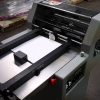
So, get your stamp adapters (either 8mm or 1/4th of an inch) and mount the stamp on the press mechanism. Next up, set the depth to reach the desired degree of compression. For this, you can either raise or lower the upper shaft of the press — but make sure that it complies with the thickness of your leather.
The best thing about rotary metal stamps? The setting remains the same for subsequent impressions on your leather goods — which means you don’t have to bother changing the setting over and over again.
3. Placement on a Firm Surface
When it comes to creating the signature bag for your brand, the stamping can’t afford to be crude. It needs precision and attention to detail. As obvious as it is, you need stability to achieve this.
That said, nothing is more stable than a firm and flat surface. Ensure that it’s non-bouncy and preferably made with steel or granite. Once you’re done with this step, you can place the stamp and the leather in rough alignment.
4. Alignment & Application of Pressure
Now comes the part where you have to ensure that the alignment works in favor of the leather product your brand is about to put out in the market.
The next thing you should do is check if the design is aligned with the edge. If it is, it’ll surely bear strong results. However, if the artisans are doubtful of the alignment, you can always suggest that they use a spare piece of leather and check to see if it’s producing the impression that you’re looking for.
If you are sure of the alignment, you can proceed to apply pressure by pulling the press hand lever down with firm & even force. Though if your rotary metal stamps are of the manual type, you may move the stamps across the surface in a slow rhythm to create a consistent & continuous pattern.
5. Drying Up & Finishing Off
The leather product, which was once damp during its prepping stages, is now almost dry. So, be sure that the leather is nice and dry before the material hardens, which ends up locking in the impression.
For a finishing touch, you should definitely try out applying a leather conditioner or oil to maintain the leather — while enhancing the details of the stamp.
Selecting the Right Kind of Leather for Branding: What to Consider
If you’ve read through the not-so-boring process of leaving an impression on your leather products, now is the time to dive into the details. Considering how the softness or malleability of the leather is integral to the process of stamping, it’s no surprise that the variety of leather with the right softness and malleability is regarded as ideal for it.
So, take a look at this table to see the whats and whys of leather type & their suitability with rotary metal stamps.
Type of Leather |
How Suitable Is It With Metal Stamps |
But… Why Is It So? |
|
| 1. |
Vegetable-Tan |
The most ideal | The firm fibers are able to absorb deep, precise, and crisp impressions which hold them even after drying up. |
| 2. |
Full-Grain Vegetable-Tan |
Ideal | Impeccable quality with dense, durable, and detailed impressions. |
| 3. |
Bridle Leather |
Good | An extension of Veg-Tan, which is oily in texture but has the ability to hold the impression of a stamp under pressure. |
| 4. |
Latigo |
Sorta Good (depends) | It’s a combination of vegetable & chrome tanning, stuffed with oils and waxes. So if it is more inclined toward veg-tan qualities, it can leave good impressions. |
| 5. |
Chrome Tan |
Unsuitable | It’s increasingly soft, which makes the stamped impressions bounce back up on the surface (like an original) and eventually fade away. |
| 6. |
Suede |
A hard pass | Fibers are quite loose, which easily tear or distort instead of compressing. |
| 7. |
Faux |
Big NO | It lacks an organic texture, having a high bounce-back factor. |
And, What Happens When Custom Metal Tags Come Into the Picture?
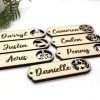
It’s one thing to know that your luggage bags and wallets have an invisible yet tactile impression of your brand’s logo. It’s another thing to realize how metal tags can also be put to good use for these products.
While nobody particularly prefers overstuffing in your product branding, it’s important to make subtle additions that don’t feel too much to customers. If you do consult with a trusted vendor to supply you with quality metal tags, you can use the same rotary metal stamps to leave an imprint on them.
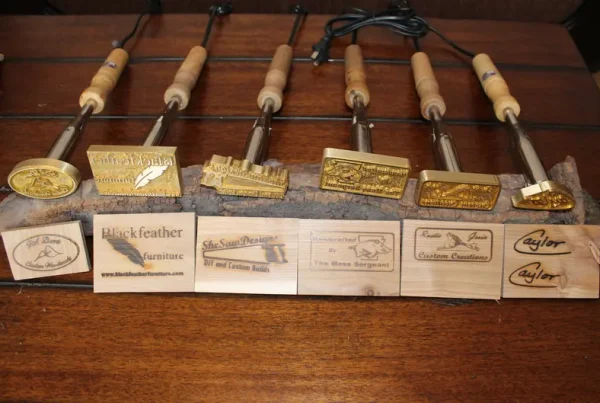
You see, that’s the versatility of quality metal stamps — they can leave a lasting impression the same way as they do for leather goods. Keyrings, handbags, belts, boots, bracelets, cuffs — and the list can go on and on.
So, depending on what your team suggests, you can assign metal tags custom to certain leather goods that can help with improving the perception of the audience.
Here’s what happens:
- The product doesn’t seem to be rustic but modern
- Your branding tactic makes the customers believe they’re holding a luxury product
- The shine or weight of the metal also gives a premium feel to the product
- A handbag with a polished gold metal tag gives an impression of a designer piece
- The brand recognition game goes strong with stamped leather products with custom metal tags
- The product also gives an impression of elevated durability
- Most importantly, it justifies the price range you set for it
Take Your Game of Personalization to the Next Level
From the tip of your customers’ shoes to the bag they sling on their shoulder — your high-end leather products make a statement in whatever room your customer walks into. So, beyond just leaving design impressions on your brand’s leather accessories, it’s important to leave a mark that represents your brand on them.
This is where rotary metal stamps become versatile at what they do. Instead of just attaching paper tags to your products (which can easily be torn off upon purchase), your customers can receive a tactile relief long after they purchase the products.
The leather, the metal, or even the handbag’s zipper — if anything, all major aspects of your brand’s products really represent where it originated from.
Needless to say, if you’re interested in bringing your personalization game to the next level, you might want to check out our wide range of customizing products and machinery at Short Order Products. We’re proud to have been serving various businesses since our establishment in 1989.
For more details on our metal stamps & tags, visit our website today!
FAQs
1. What’s the correct method to stamp text on leather?
The correct method to stamp text on leather is to primarily choose the right type of leather. After that, you’re supposed to case the leather (dampen it), use metal letter stamps, and apply firm yet controlled strikes with a mallet on the solid surface.
2. What else can I customize using a rotary metal stamp?
Usually, rotary metal stamps are made up of hardened tool steel, which acts as a versatile customization medium to mark materials besides leather. Few things that you can customize with the help of a rotary metal stamp:
- Softer metals → aluminum, brass, copper, sterling (fine silver)
- Harder metals → mild steel, stainless steel
- Wood → timber, wine barrels, furniture
- Clay & ceramics → pots, vases, tiles
- Thin sheets → plastic, paper, cardstock, canvas
3. What kind of metal is considered best for stamping on leather?
Leather is a delicate yet sturdy material to stamp on — it’s only obvious that it requires a heavy-duty stamping material. For this reason, hardened steel is the top choice for durability, whereas brass takes the crown for fine detailing & hot stamping.
4. Is it true that businesses with stamped leather products make good money?
Yes, businesses specializing in stamped leather goods and customized varieties are recorded to be quite profitable. People feel generally inclined towards products that give a sense of a premium feel. So naturally, the profit margin is quite high for such businesses.
5. What will happen if I use the wrong kind of leather for metal stamping?
It is not generally preferred to use the wrong kind of leather for metal stamping purposes. The reason lies in the impermanence (temporality) of the stamped impressions — noting how they either fade or blur over time.