Have you ever paid attention to the tag that your dog wears? Notice how the most essential information is written in such a small space? That’s intentional precision you’re looking at.
The artisans responsible for engraving and embossing the most intricate designs on various materials understand the value they hold in the market. Pets, jewelry, watches, tumblers, electronics, cars, industrial-grade equipment — there’s no category you wouldn’t find this identification marker in.
That said, there’s a thin yet prominent line between these two surface treatment techniques.
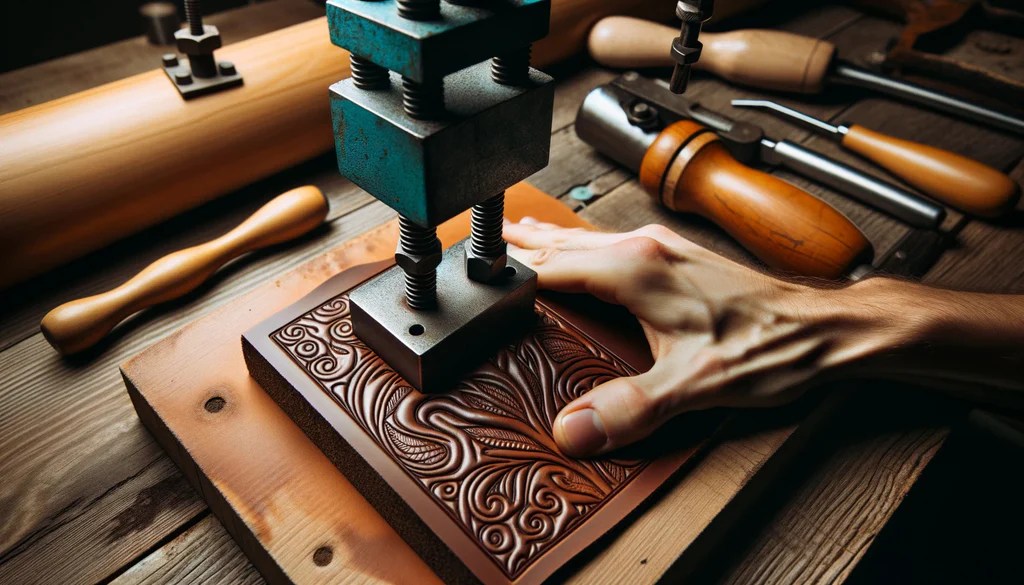
Two words — pressure and cut. An embossing machine applies pressure to raise a design above the surface. In contrast, laser engraving cuts away bits & pieces of the surface to create a deep & detailed mark — offering unmatched durability.
The truth is, embossed and engraved products are everywhere. The only thing you have to do is peek a little closer.
Keep reading to dive into the details.
How the Results Differ — Embossing Machine vs Laser Engraving
It’s not everyone’s expertise to use embossing machines or laser engraving equipment efficiently. Paired with the right knowledge of materials and technique, one needs the artist’s perception to bring an idea to reality. So if you’re interested in running a business for customized products, then you’re just at the right place.
It doesn’t matter if the material is a piece of paper, leather, metal, wood, or glass. From the moment a craftsman uses either of the machine to the instant they finalize the product — precision is necessary.
Skim through the table below to get a detailed breakdown of their differences.
Feature |
Embossing |
Engraving |
|
| 1. |
Medium |
Physical pressure | Thermal action |
| 2. |
Method |
A custom metal die is used to press a design into the material’s surface. | A high-intensity laser beam is used to carve into the surface by vaporizing a controlled amount of the material. |
| 3. |
How It Looks |
Dramatic popped appearance — light hitting raised areas differently — creating soft shadows — accompanied by highlights. | Sharp, clean, and highly defined edges — creating shadows and highlighting the design. |
| 4. |
How It Feels |
Tactile, tangible, and soft texture — feeling like a distinct bump or a raised texture for better grip. | Prominent groove feel, with a rough or gritty texture — primarily attributed to carbon residue. |
| 5. |
Visual Perception |
Elegant, classic, and matte with soft and rounded edges. | High contrast, prominent, precise, and darker than the original surface. |
| 6. |
Detailing Capacity |
Bold, simple, and large designs. | Fine lines, high-detail, small & complex text. |
| 7. |
Typically Used Materials |
Paper, thin metal, leather, and fabric. | Wood, leather, glass, metals, plastics, and acrylic. |
| 8. |
Speed |
Very fast (ideal for large-scale batch production). | Slower (versatile for one-offs). |
| 9. |
Cost of Setup |
High (requires die and mold for every design) | Low (software-driven) |
| 10. |
Purpose |
Product branding, luxury packaging, wedding invitations, and leather goods. | Industrial marking, jewelry personalization, and engraving intricate photos or logos. |
As you can see, both surface treatment techniques are distinct in their methods, effects, and purposes. So, it depends entirely on the businesses or individuals who approach you to customize their goods. Their preference helps determine whether the work should be done with a laser engraving machine or an embossing machine.
Why Do These Techniques Exist In the First Place?
No product, service, or technique exists without a reason. In a modernized era, everything serves a purpose that benefits the public in the long run.
If you take a look back at history, numerous art forms have originated in different societies for a variety of purposes. Those ancient relics that archeologists come across? That’s less of an object and more of an artifact. So if you think that embossing or engraving is a modern technique, you couldn’t be any more wrong.
Historically, people used to manually cut up material — such as metal, wood, or stone — to create a design. Engraved designs were either used as inscriptions, decorations, or prints. On the other hand, the embossing technique has existed for thousands of years, primarily used to create raised designs.
Shifting the focus to 2026, these surface treatment techniques haven’t become redundant. As a matter of fact, businesses and consumers prefer tactile products that offer:
- Value and luxury
- Distinctive branding
- Customization
- Artistic expression
- Increased strength
- Improved grip
- Textured feel
- Absorption
- Markings
- Protection
- Unreproducible designs
- Accessibility
People don’t want their optical vision to be the only sensory experience that helps them identify. They also want to have their sense of touch to act as an extension. Something that can be interpreted without looking at it — like rifling through a drawer to find the keychain your friend once gifted to you.
Needless to say, embossing and engraving techniques add structural, functional, and aesthetic value to materials — turning smoothened, 2D surfaces into 3D ones.
Compatibility: What Kind of Products Are They Good For?
If you’re about to gather equipment and resources to start your customization business, this section will come in handy. From embossing machines to laser engraving machines — the choice can be a bit hard to make when you don’t know which technique and product material go well with each other.
While both surface treatment techniques are used to leave a lasting mark on a wide variety of materials, you have to be selective about them. There’s no one-size-fits-all kind of situation here. Both the techniques are distinctive — and so are the product materials.
If you pair incompatible techniques with the right product materials — your experimentation is going to cost you resources. To steer clear of this trouble, here’s a cheat sheet you can benefit from.
Category |
Products |
||
Embossed |
Engraved |
||
| 1. |
Industrial & Safety |
Asset tags | VIN plates | safety valves | pipe tags | pump tags | machinery nameplates | conduit markers | Serial numbers | QR codes | barcodes | calibration markings | tool tracking | medical instruments |
| 2. |
Branding & Signage |
Logo plaques | promotional badges | high-end product labels | metal business cards | Metal nameplates | desk signs | architectural signage | directional signs |
| 3. |
Luxury & Consumer Goods |
Decorative perfume bottles | wine bottle labels | gift boxes | metal packaging | Personalized tumblers | metal pens | watches | flasks | Zippo lighters |
| 4. |
Jewelry & Accessories |
Statement jewelry | stamped pendants | textured bangles | stamped rings | Wedding bands | lockets | memorial jewelry | custom rings |
| 5. |
Automotive & Aerospace |
Decorative interior trim | grilles | heat shields | aluminum dash panels | VIN plates | engine components | aerospace paneling |
| 6. |
Home & Functional |
Decorative panels | elevator interior panels | ceiling tiles | textured metal sheets | Kitchen utensils | personalized kitchen knives | custom cutlery |
Making a Fair Decision: To Emboss or Engrave?
To arrive at a conclusive point can be quite the task. Since the ball’s in your court, you must be feeling the pressure of deciding between the two surface treatment techniques.
So, what’s it going to be — an embossing machine or a laser engraving machine?
When you have all the facts (and the cheatsheet), you can assess the scenario more effectively.
You Should Emboss If…
- The material is leather, paper, linen, or a soft metal.
- You want bold and simple designs.
- Your goal is to have a luxurious feel.
You Should Engrave If…
- The material is metal, glass, wood, plastics, or dense leather.
- You want fine, detailed, and intricate designs with complex patterns.
- Your goal is to have a modern, sleek, and highly polished feel.
Gear Up With the Right Equipment Today!
Starting a venture is not easy, but you can always seize the opportunity by forming a clear understanding of what you’re dealing with. Instead of running around finding the right equipment — not to mention the trial-and-error process — it’s better to gear up with the right equipment at the right time.
A quality embossing machine or laser engraving machine, with a range of metal tags, metal plates, metal disks, and metal badges — now that sounds like a good starting point for your business. At Short Order Products, you can easily shop for a variety of products. Not just that, we also have an extensive range of metal tags with suitable embossing & engraving equipment.
So, what’s your call?
FAQs
-
Can I engrave and emboss with the same machine?
Yes, it is possible to emboss & engrave with the same machine — depending on what type of machine you’re actually using. If your budget allows, you can opt for laser engravers with 3D capabilities or desktop cutting plotters.
-
Do I need to be cautious about the materials before embossing?
It’s important to be cautious about selecting materials prior to embossing. If you have the right equipment but the wrong material, it can potentially damage your equipment & ruin the material itself with a poor-quality design.
-
How many types of engraving are there?
There are five primary types of engraving, namely: (1) hand, (2) laser, (3) CNC (computer-numerical-control), (4) rotary, and (5) diamond drag.
-
What engraved items sell best?
Engraved items such as custom glassware, cutting boards, tumblers, keychains, pet tags, leather wallets, and coasters are known to be the best-selling engraved items between 2025 and 2026.
-
What’s better, engraving or embossing?
It all comes down to your priorities. If your goal is to have a durable finish with fine details — on metal, wood, or leather — then engraving is a suitable option for that. On the other hand, embossing machine is good for flexible materials.